Professional chair massage at work, at your office or at events. One-off or as a recurring massage for your staff, with flexible scheduling, simple bookings and measurable results.
Chair massage in the workplace is more than a perk, it is a strategic investment in the health and productivity of your employees. In just 20 minutes, a chair massage for staff lowers stress, improves blood flow and boosts focus. That makes corporate massage a preventive part of your vitality policy, contributing to sustainable employability and lower absenteeism.
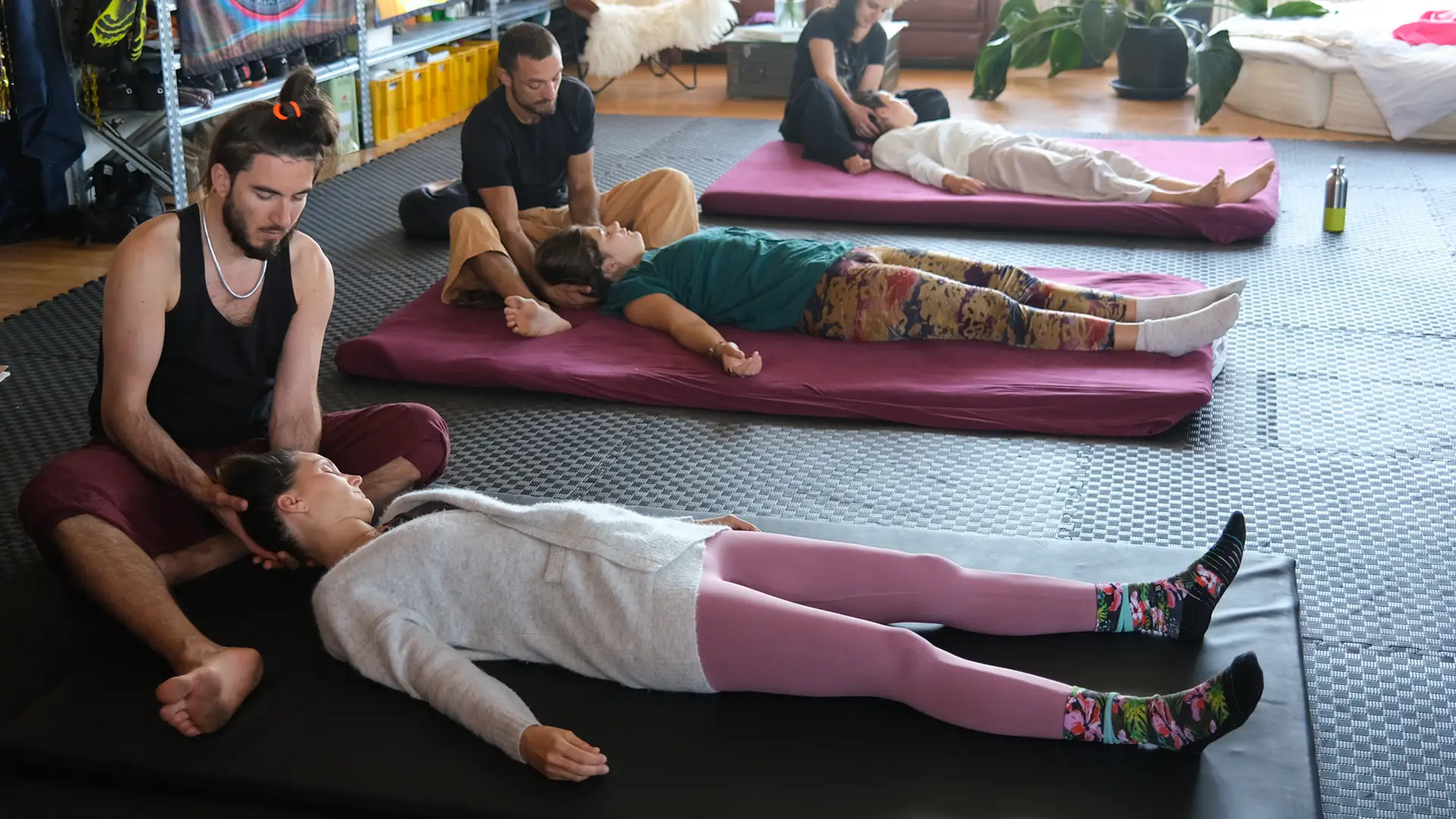
Besides the short chair massage on the massage chair, I am also available for longer corporate massage on the table and on the mat: a combination of dynamic stretching, compression and pressure points, fully clothed and without oil. Hardly any provider in the Netherlands offers those longer treatments on site, and for most employees it is a unique experience.
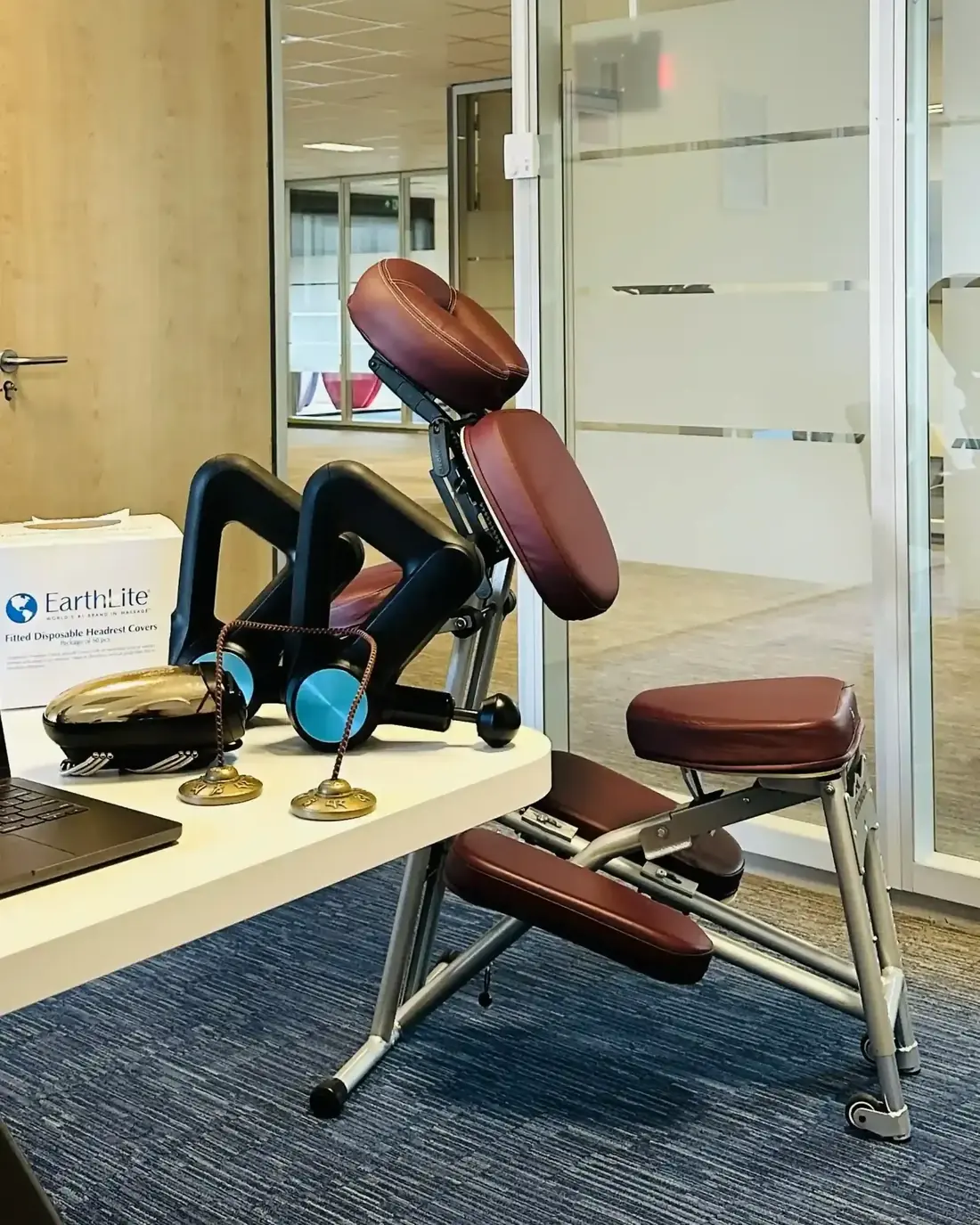
If the space allows, I also bring tools such as the theragun, and sound healing for deeper relaxation. With a decade of experience I provide corporate massage for offices and production companies, schools and universities, government bodies, hospitals and care institutions.
Because of my unique treatment methods, companies from all over the Netherlands work with me.
Wellness programmes show that you invest in your people. This makes you more attractive to top talent.
Better job satisfaction
Massage breaks the daily grind and creates shared positive experiences. Good for morale and mutual connection.
Incentive to come to the office
Make office days more appealing with a weekly chair massage day. A reason to come in.
Tax benefit
Chair massage at work can fall under the ARBO scheme or the WKR tax-free allowance. A wellness investment with a fiscal advantage.
0
Employees massaged
At offices throughout the Netherlands
0
Years of experience
Professional chair massage
0
Average review
From hundreds of Google reviews
0
Available nationwide
We come to you
A wellbeing programme without the admin for HR
No hassle with planning or logistics. I take the booking process, promotion and organisation off your hands so all you need to do is tell me when to come.
Online booking tool
Employees sign themselves up, and can easily change or cancel. HR receives a participation report afterwards.
Posters with QR code
I create promotional materials for your office. Share the link by email plus a poster by the coffee machine and the slots fill up fast.
Discount with a contract
Ongoing partnerships mean sharper rates. The more often we come, the better the deal.
What does the research say about massage at work?
Independent research shows measurable effects on complaints, absenteeism and productivity. Studies at Maastricht University by drs. Ton van Attekum and figures from TNO back up what participants notice after just three treatments.
63%
fewer RSI complaints
Maastricht University (drs. Ton van Attekum), after 16 weeks of weekly chair massage
67%
fewer tension complaints
Maastricht University, noticeable after three treatments
27%
lower absenteeism
TNO, vital employees vs average
18%
higher productivity
TNO, vital employees vs average
Types of corporate massage on location
Chair massage
15-20 min per person
Fully clothed, no oil. Focus on neck, shoulders and back. Ideal at the workplace, at trade fairs and events.
Table massage
30-90 min per person
Deeper relaxation with passive stretching and pressure points, on a table or mat, clothed, no oil. Ideal for smaller teams or management.
Workshops and team building
2-4 hours for groups
Teach colleagues to massage each other. Connecting, educational and fun. Perfect for team-building days.
Meet the team! For larger bookings I bring colleagues: male and female therapists, so every employee can choose who treats them. Cultural and religious preferences are respected as a matter of course.
How a chair massage day works
Employees are scheduled in advance via the online booking tool. I come to your location on the agreed day with everything I need. Each participant gets a brief intake followed by a treatment tailored to them. After the massage I'll give a short tip on posture or exercises where useful. All you need to arrange is a quiet space with about 3 by 3 metres of clear floor space per therapist.
My approach: personal and complaint-focused
I work with a combination of pressure points, passive stretching and kneading. In 15 to 20 minutes I can work deeply, not just relaxing but noticeably relieving complaints. No two massages are the same.
For larger bookings I work with a small, regular team of colleagues, so I can scale up without giving up quality. Everyone I work with has at least five years of experience and is insured.
That also means employees can choose between a male or female therapist, leaving room for everyone's comfort, preference and any religious or cultural considerations.
One-off or ongoing
Both work. A one-off visit is great as a reward after a busy quarter, during a wellness week or as a surprise at a company day. The greatest effect comes with regularity though: at least once a month, ideally once every two weeks. Research shows the effects are noticeable after just three treatments.
How often? In practice 'more often' nearly always wins.
Corporate massage in Ede, the region and beyond
My studio is in Ede, centrally located in the country, which means I am on site quickly. I provide corporate massage and chair massage on site in Ede, Wageningen, Veenendaal, Barneveld, Arnhem, Amersfoort, Leusden, Utrecht, Houten, Zeist, Apeldoorn and Nijmegen, and regularly further afield in Amsterdam, Rotterdam, The Hague and Delft.
Companies across the country invite me in for my unique treatment methods and personal approach. They prefer that over a national agency staffed by rotating temporary workers.
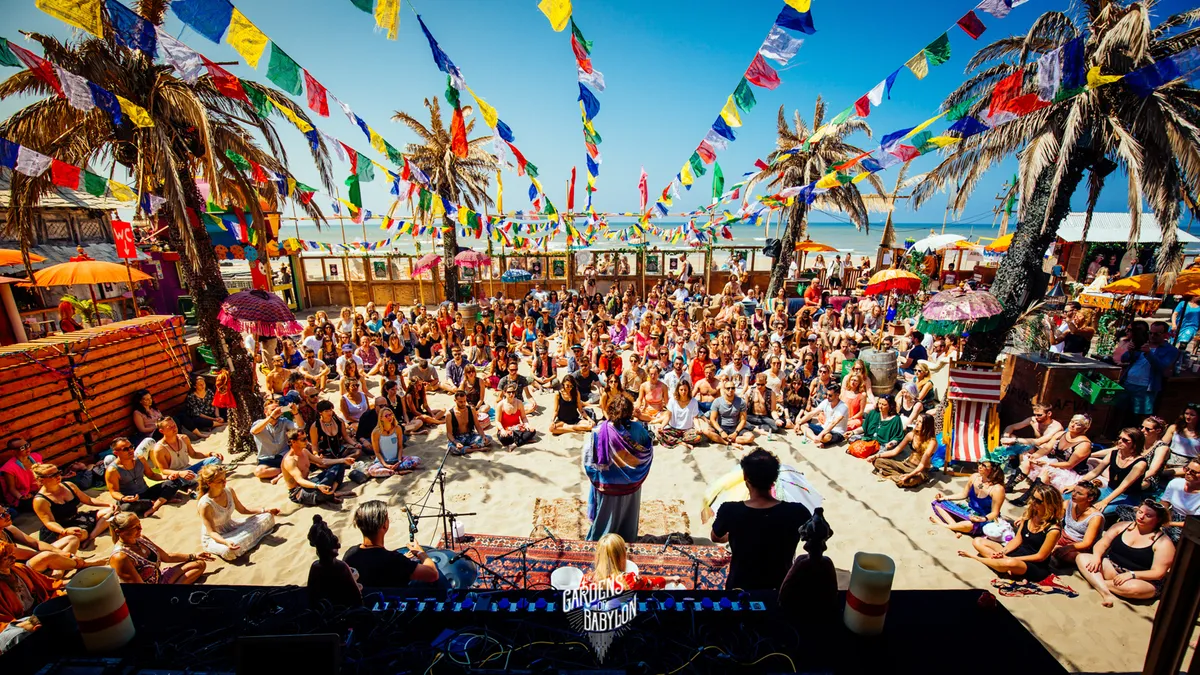
Chair massage at trade fairs, events and company parties
I provide chair massage at trade fairs and conferences, including at the RAI in Amsterdam, the Jaarbeurs in Utrecht and Ahoy in Rotterdam. A chair massage at your trade fair stand keeps your stand staff fresh through long fair days, and draws visitors to your stand: a massage chair stands out among the flyers and the screens.
I also provide massage at company parties, staff days, team outings, product launches and brand activations. As the organiser it shows straight away that you care about your guests' wellbeing.
Motion creates emotion: an experience people feel stays with them and leaves a lasting positive impression on everyone you invited.
What does corporate massage at work cost?
Everything I provide is tailored. The price depends on the number of therapists, the size of the team and how long the treatments last. Whether the booking falls during the day, in the evening or at the weekend matters too, as does the location and whether it is a one-off or a recurring arrangement.
For recurring bookings the rates are sharper: the more regular, the bigger the discount.
Get in touch for a tailored quote. How it works out for tax is explained below.
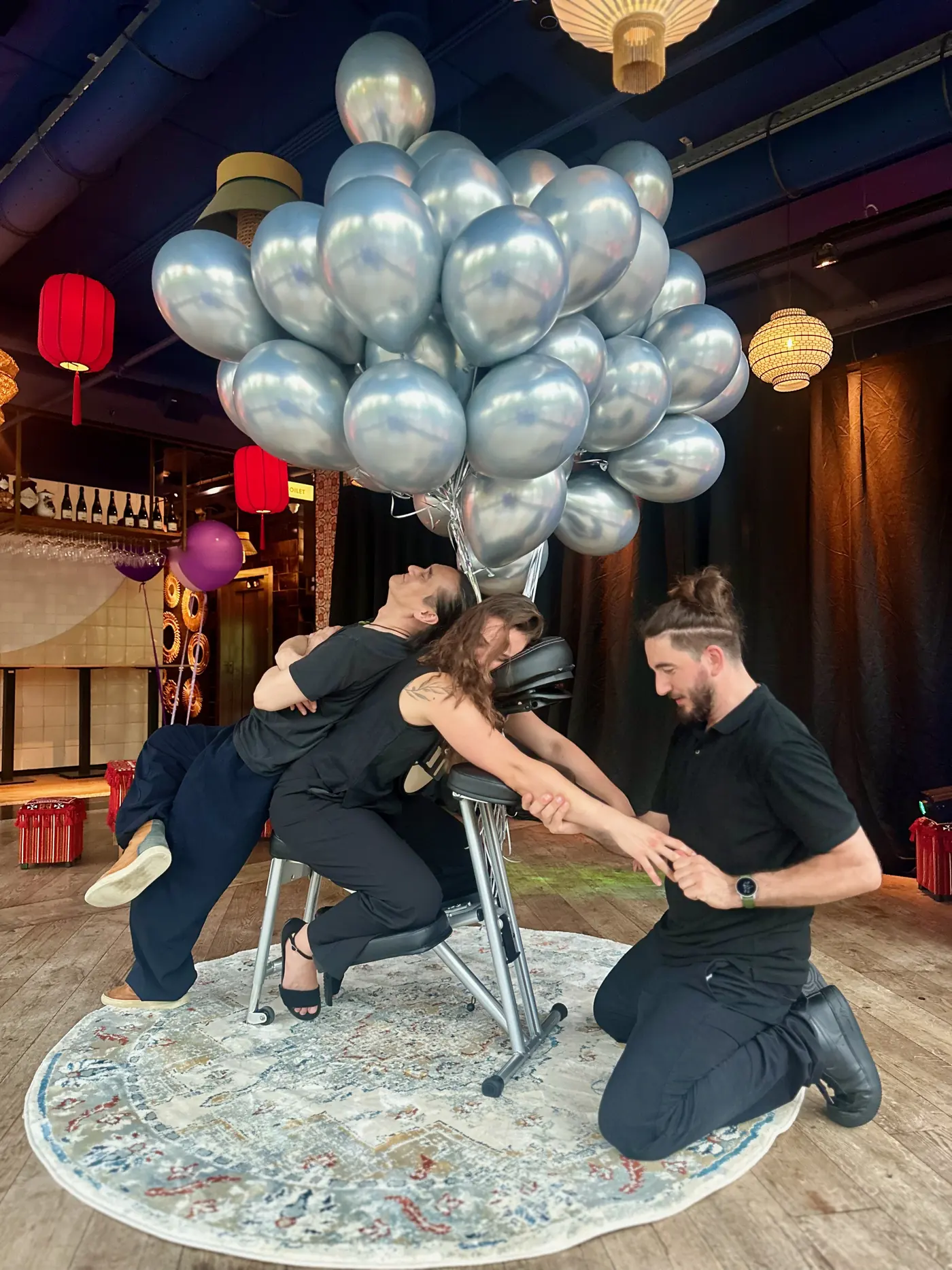
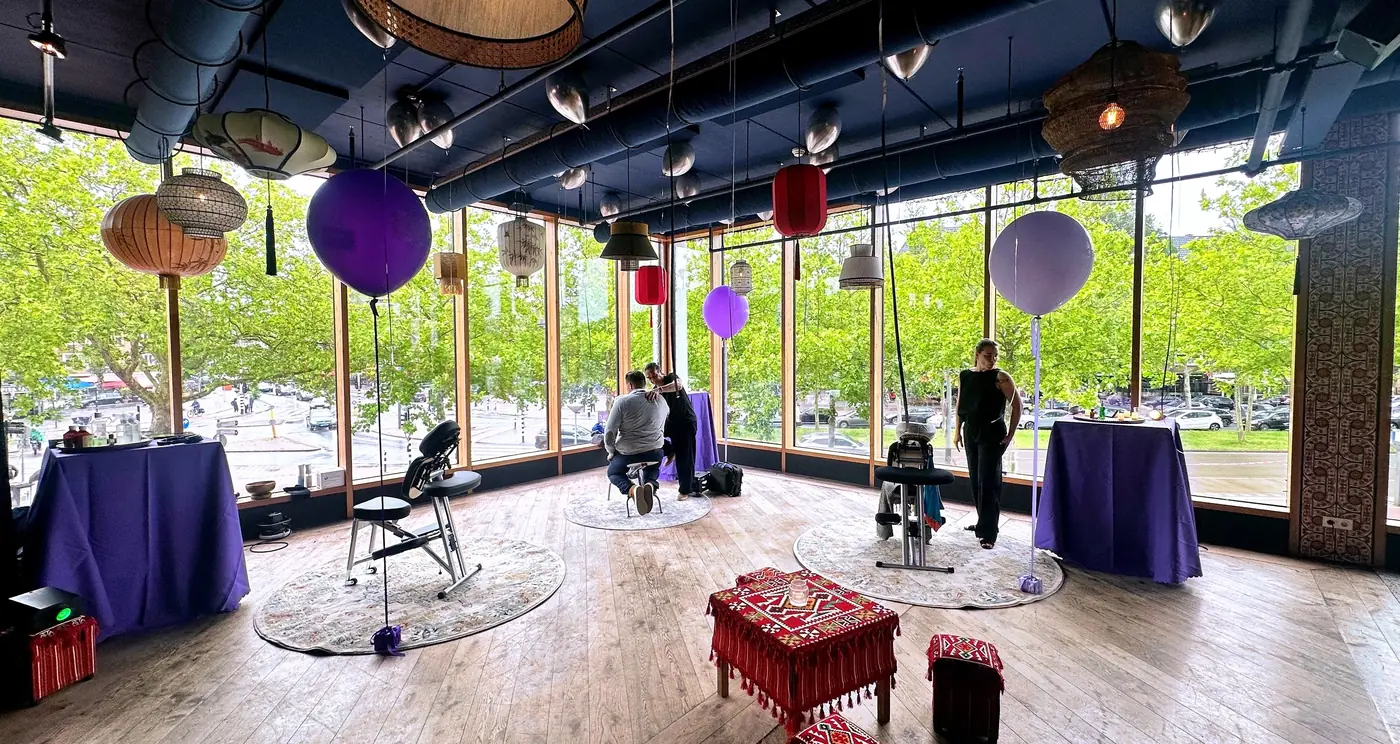
Chair massage for global senior professionals at a networking reception in the Traveller, during a multi-day business event at the RAI in Amsterdam.
Corporate massage and the Dutch tax office: three routes
Chair massage at the workplace is tax-friendly. Which route applies to your situation depends on where the massage takes place, how you arrange it and who is being massaged.
Massage op de werkplek
€0belast
Nihilwaardering
Wordt de massage op de werkplek aangeboden, dan kan die binnen de werkkostenregeling (WKR) op nul worden gewaardeerd: onbelast, en niet ten laste van je vrije ruimte.
De massage vindt plaats op de werkplek
De werkgever huurt de masseur zelf in
De werkgever betaalt de volledige kosten, geen eigen bijdrage
Als de nihilwaardering niet opgaat
2%van je loonsom
Vrije ruimte
Gaat een van die voorwaarden niet op, dan boek je de kosten in de vrije ruimte van de werkkostenregeling (WKR).
2% over de eerste €400.000 loonsom
1,18% over het meerdere
Boven het budget: 80% eindheffing
In 2027 stijgt de eerste schijf naar 2,16%
Massage voor niet-werknemers
100%aftrekbaar
Reguliere bedrijfskosten
Voor mensen die niet bij jou in loondienst zijn: ingehuurde zzp’ers, of gasten op een beurs of evenement.
De factuur is aftrekbaar als bedrijfskosten
Nihilwaardering en vrije ruimte gelden alleen voor loondienst
Geen gevolgen voor de loonadministratie
This information has been compiled with care based on regulations current in 2026. Michalis Massage is not a tax adviser: always consult your accountant or tax adviser for your specific situation.
Which budget pays for corporate massage?
Rarely a new budget. Usually something that is already there.
Absence insurance
Often an intervention budget for treatments that prevent or shorten absence.
Collective health insurance
Usually a vitality budget per insured employee. Note: it expires at the end of the year.
Education
The workload reduction funds, which staff decide on themselves. In higher professional education also the decentralised employment conditions funds.
Healthcare and government
The sustainable employability budget, or an employee's personal choice budget.
Your sector's training fund
Almost every collective agreement has one, with a pot for healthy and safe working.
"When we take care of our wellbeing, we perform better. When we perform better, we feel better."
— Arianna Huffington
Flexible treatment duration: from 15 to 90 minutes
A chair massage lasts 20 minutes on average, with 15 or 30 minutes as alternatives. For smaller teams I work longer on the table or mat: 45, 60, 75 or even 90 minutes. Hardly any provider offers that on site.
Shiatsu and Thai massage at work: chair, table or mat?
I do not work with a single technique, but with a blend built up over the years: dynamic Thai yoga massage, shiatsu with stretches, pressure points and deep relaxation. Fully clothed and without oil. Where it suits, I also bring a massage gun and singing bowls.
On the chair you sit and I focus on back, neck, arms and shoulders: quick and targeted, ideal for large groups. On the table or mat you lie down and I work through the whole body: deeper and more relaxing.
Which format fits depends on the work. With office work the complaints sit in neck, shoulders and upper back, and the chair is enough. With standing, lifting or walking work, such as production, warehousing, technical work and care, they sit in the lower back, hips and legs, which I reach better on table or mat.
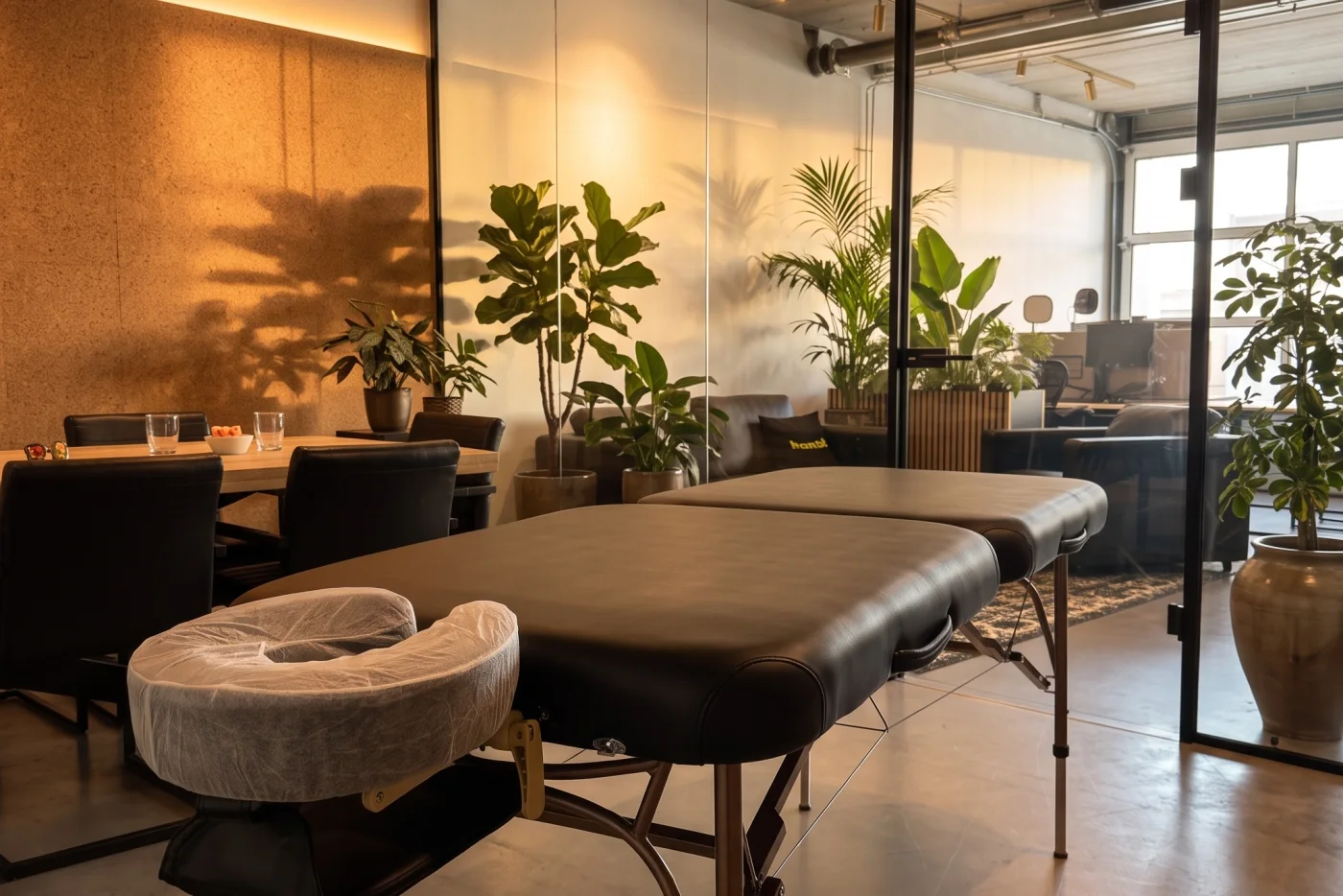
A table treatment on location: the table fits into a meeting room or a quiet corner of the office.
Who benefits from corporate massage?
Office workers and screen-based work
Anyone who spends hours at a screen each day gradually slips into a bad posture. Shoulders creep up, the neck stiffens, the lower back gets overloaded.
Chair massage targets exactly these complaints and helps prevent RSI, tension headaches and chronic neck pain.
Production, logistics, healthcare and retail
It's not just desk work that takes a toll. In production, logistics, healthcare and retail too, corporate massage releases tension and keeps muscles supple.
The advantage: production simply carries on. One person is away for twenty minutes, instead of losing a whole team for an hour to company gym sessions or yoga.
Small teams and freelance offices
Chair massage isn't just for large companies. In a small team, personal attention makes all the difference.
My minimum booking is 3.5 hours, half a day. With a small team it works well to take longer treatments and to book every two weeks or monthly rather than weekly.
The positive effect of workplace massage
An investment whose effect you notice straight away. What the employee gains physically and mentally, the employer sees back in energy, focus and lower absence.
For the employee
Relief from neck, shoulder and back complaints
Reduction in work-related stress and cortisol
Better circulation, more supple muscles
More energy, focus and concentration
Reduction in headaches and RSI
Stimulation of endorphins
Nice bonus: discount on treatments at my studio in Ede
For the employer
Less short-term sick leave
Higher productivity and engagement
Stronger employer brand
Lower staff turnover
Fully managed via the booking tool
100% tax-deductible via nil valuation
Discount with an ongoing contract
Chair massage on theme days and vitality weeks
Chair massage is a perfect fit for national theme days. The key dates in 2026:
Week Without Work Stress
9 to 13 November 2026
National Vitality Week
21 to 27 September 2026
Day of Vitality
21 September 2026
National Stress Awareness Day
4 November 2026
Secretary's Day
16 April 2026
World Mental Health Day
10 October 2026
Blue Monday
19 January 2026
World Day for Safety and Health at Work
28 April 2026
International Nurses Day
12 May 2026
Popular dates fill up quickly. Get in touch early.
What clients and employees say
L
Lucinda AllenHR Manager
★★★★★
"Hired Michalis to massage my team during our annual summit. He was super professional to deal with and many of my team said it was the highlight of the event!"
November 2025
S
Seph Fontane PennockCEO
★★★★★
"We hired Michalis to give chair massages to our team at our company gathering. Everyone loved it! Professional communication and super friendly service."
October 2024
S
Stacey MeulenaarEmployee
★★★★★
"Wonderful chair massage. I had no idea you could feel so relaxed and loose in just fifteen minutes. Highly recommended!"
November 2024
C
Chantal MEmployee
★★★★★
"A great deep massage at work. I came out completely relaxed even though the environment was busy. Thank you!"
January 2025
Y
Yvonne HoffmannEmployee
★★★★★
"I just had a super massage! Totally happy and completely relaxed in no time!"
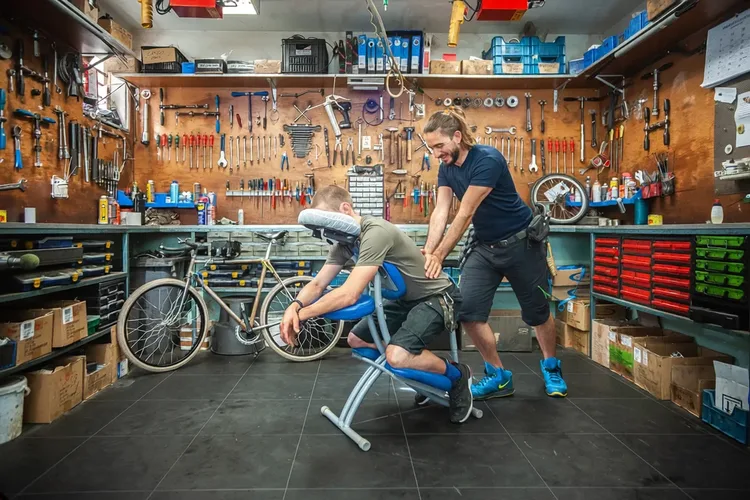
Chair massage is a short, focused massage of 15 to 20 minutes on an ergonomic massage chair. You stay fully clothed and no oil is used.
The focus is on the neck, shoulders, back, head, arms and hands, exactly the places where tension builds up at work.
The standard duration is 20 minutes. Options of 15 or 30 minutes are also available. For small teams I also offer longer table or mat treatments.
From 15 to 90 minutes, depending on the format.
In the chair: 15, 20 or 30 minutes. Twenty minutes is the standard and works best for most teams, because everyone gets a turn within one half-day.
On the table or mat: 45, 60, 75 or 90 minutes. That is a full treatment, suited to smaller groups.
Mixing is fine too: twenty minutes in the chair for most staff, and a double slot for anyone who could use extra attention.
No. All corporate massages I give are done over clothing and without oil. The emphasis is on pressure points and stretching, though I can also use kneading movements with a special smooth cloth that allows gliding strokes.
Wear comfortable clothing you can move freely in, and leave jewellery off.
One small request: please come without heavy perfume, aftershave or deodorant. I work close to people all day and strong scents linger in the room.
Each therapist needs roughly 3 by 3 metres of floor space, enough room to move freely around the chair. I massage everywhere: meeting rooms, canteens, exhibition floors, rooftop terraces and gardens.
A bit of privacy makes a difference; employees relax faster when they don't feel watched.
When choosing a space, bear in mind that a table or desk may need to be moved, and check whether any cables are fixed in place.
Between every treatment I clean the chair: the seat, the arm rests and the leg cushion. For the headrest I use single-use covers, so everyone gets a fresh one.
I wash my hands between treatments and work with clean materials. I ask the same of employees: give your hands a wash before you come over.
I bring a bit of calm along to the office. A speaker with soothing music comes with me, and if you like, some essential oils for a pleasant scent in the room.
That works both ways. Whoever is in the chair settles more quickly, and whoever walks past notices something out of the ordinary is going on.
Who is it for, and does it work?
Office and government
Screen workers, policy staff, local government employees — they often sit in the same position for hours. Chair massage relieves neck complaints, headaches and shoulder tension, and fits seamlessly into an occupational health or vitality policy.
Healthcare and education
Nurses, care workers, teachers and teaching assistants carry a high physical and mental load. Chair massage is a low-threshold way to show appreciation and open up the conversation about burnout.
Production, logistics and physical work
Warehouse staff, production workers and people in construction or industry put their bodies under heavy strain every day. A chair treatment relieves muscle tension in the back, shoulders and arms, without needing to get changed or leave the workplace for long.
Retail and hospitality
Lots of standing, little time to rest. Chair massage also fits in a small staff room and gives employees a well-earned moment of recovery during a busy season.
Universities, colleges and research institutions
Students, lecturers and researchers under high work pressure — chair massage fits well with student wellbeing and employee satisfaction initiatives.
Events, trade fairs and conferences
Stand staff and organisers are on their feet for hours. A chair massage on the exhibition floor or during a conference is an eye-catcher and a gift for your team or visitors.
In short: chair massage is widely applicable, requires minimal preparation and fits into any vitality policy, from SME to multinational, from hospital to local authority.
The chair works well for neck, shoulder and upper back complaints, and those mostly come with screen work. With standing, lifting or walking work the complaints sit in the lower back, hips and legs. I reach those better on a table or mat, and I can bring that on location too.
Tell me what kind of work your people do and I will match the format to it. For technical, transport and production sectors the collective agreement often includes a training and development fund with a budget for healthy and safe working.
In cases of fever, a cold, acute infections, skin conditions in the massage area, recent surgery or fractures, or severe acute back complaints. If in doubt, we'll discuss it beforehand.
Yes, that is one of the main reasons chair massage is used.
First the terms, because they get mixed up. RSI is the older name. Occupational health professionals now speak of CANS: complaints of the arm, neck and/or shoulder. Mouse arm is the everyday term. They all cover the same group of complaints: pain and tension from repetitive movements or holding the same posture for long periods.
Research at Maastricht University among 76 office workers found that 63% of participants experienced fewer complaints after 16 weeks of weekly chair massage. The first effects were noticeable after just three treatments.
One caveat: massage does not remove the cause. If a workstation is set up badly, address that first. Massage works alongside it, not instead of it.
Yes. Absolutely. Employees experience an average of 40% less stress after a treatment. Massage lowers cortisol and stimulates endorphins. You'll notice that everyone walks around a lot happier after a treatment.
At least once a month, ideally once every two weeks.
The effects are noticeable after just three treatments.
And it's a good reason to come into the office.
No. There is no law obliging an employer to offer massage.
What is required is occupational health policy: a risk assessment and evaluation, a plan of action, and measures against physical strain and work pressure. Which measures those are is up to you. Massage can be one of them, alongside workplace assessments, scheduling measures or coaching.
If you are looking for something that is mandatory, it is the periodic offer of an occupational health examination. That is set out in article 18 of the Dutch Working Conditions Act: offering it is compulsory, taking part is not.
For the immediate effect the case is strongest: less muscle tension in the neck and shoulders, and the feeling of having stepped away for a moment. People notice that themselves straight away, and it is usually what a team expects from it.
For the long term I will be more honest: massage does not remove the cause. If someone sits badly for eight hours a day, a good chair or a workplace assessment does more than a massage once a quarter. It works best as part of a wider approach, not as a standalone plaster.
What is often underestimated is the effect on atmosphere. Someone taking time for you during a working day does more than the treatment itself. That is not a small gain, but it is something other than a medical claim.
Honest answer: nobody can give you a hard return figure, and anyone who does is working from assumptions.
What you can compare is the cost side. A single day of absence quickly costs more than offering one employee regular massage for a whole year. Prevent one person from dropping out and it has paid for itself.
The second part is less measurable but more visible. As an employee benefit, massage stands out because staff notice it immediately, unlike most things that appear on the payslip. It comes up in conversations, in the newsletter and with job applicants.
On the day itself you see it straight away. Employees walk out looser and visibly more comfortable in their own skin, and that carries through to the mood on the floor. At the same time it reads as recognition for their work and commitment: time and attention are set aside for them, in the middle of an ordinary working day.
You certainly can, and there is a clear advantage: a massage chair is always there. No diary, no scheduling, people use it whenever it suits. With one caveat, because that only holds as long as the device is properly maintained.
What it cannot compare with is human work. A mechanical chair runs a fixed programme and feels the same for everyone. I feel where the tension sits and adjust pressure and technique accordingly, and that differs per person and even per session.
And there is the part no device can deliver: attention, personal contact and a smile. A large part of the effect lies in someone taking time for you. That is also what gets talked about on the work floor.
The two are not mutually exclusive. A chair in the break room for in between, and someone coming by a few times a year, complement each other well.
What you tell me about your body or your health stays between us. I do not report individual employees' complaints: that is personal data and I handle it carefully.
What the employer does receive is the attendance list, so who came along. That is needed for scheduling and invoicing.
Beyond that, I can report back at team level where there is reason to, for example that I notice a lot of tension or work pressure in a department. That is always about the whole and never about who said what.
How it works in practice
It depends on the treatment duration. At 15 minutes that's 4 people per hour, at 20 minutes it's 3, at 30 minutes it's 2.
Here's an example based on 20-minute treatments:
Half day — 4 hours (09:00–13:00 or 13:00–17:00) Including 20 min break · net 3h40 · 11 treatments per therapist
Full day — 8 hours (09:00–17:00) Including 3 breaks (20 + 40 + 20 min) · net 6h40 · 20 treatments per therapist
Breaks are always 20 minutes (or multiples thereof), so they slot seamlessly into the rhythm of the treatments. With a morning block we have lunch afterwards; with an afternoon block, before.
Certainly. As a reward, after a busy period, on a vitality day, during a company party, on Secretary's Day or as an end-of-year surprise.
...But be warned: there's a good chance the team will want this again afterwards!
Chair massage lasts 15 to 30 minutes, focuses on the neck, shoulders, back and head, and is ideal for large groups.
A table or mat treatment lasts 30 to 90 minutes, works the whole body and goes deeper, using shiatsu and dynamic thai yoga massage.
Both are given fully clothed, without oil.
Both are possible. Chair massage is the quickest format: seated, fully clothed, 15 to 30 minutes. That makes it the best choice when a large group needs to be treated.
For smaller teams, leadership or a select group I work on the massage table or on a mat. Such a treatment lasts 45 to 90 minutes and covers the whole body, using shiatsu and dynamic Thai yoga massage. That one is clothed and oil-free as well.
Both formats can run side by side within one booking: the chair for throughput, the table for those given more time.
In most cases, yes. I have experience with pregnancy massage and adapt the technique accordingly.
Yes, absolutely. In the past ten years I've learned a wide range of techniques and given thousands of treatments, on retreats, at events, at companies and in my own studio. All of that experience comes with me to your workplace. My treatments are personal and always tailored, and I guarantee that everyone on your team is in good hands.
Yes, of course — you're very welcome to come for a trial treatment at my studio. Or we simply book a day or half-day on location so you can see straight away how your team responds.
Yes. I'm your regular therapist, and for larger assignments I work with a small team of colleagues. I get to know your team and remember complaints and preferences, not a rotation of new faces like you'd get with a large agency.
Yes, of course.
For larger events or teams I can scale up with colleagues. Get in touch to discuss what your situation calls for.
Yes. For larger assignments I work with a female colleague, so employees can choose. This way we take everyone's comfort and any religious or cultural considerations into account.
No problem. Chair massage is always voluntary. Sceptics often join in next time after seeing enthusiastic colleagues come back glowing.
Yes. I hold both general business liability insurance and professional indemnity insurance.
When I work with a colleague on a larger booking, the same requirement applies: I only work with practitioners who are insured themselves.
I'm active nationwide. My studio is based in Ede, centrally located in the Netherlands, so I travel easily to Utrecht, Veenendaal, Wageningen, Arnhem and Amersfoort. I also regularly visit companies in Amsterdam, Nijmegen, The Hague, Rotterdam and Delft.
Companies enjoy working with me because of my personal approach and the range of what I offer — that's what makes the difference.
Yes. From my base in Ede I work throughout the Netherlands, and for larger bookings or several locations at once I work with a network of qualified therapists.
With multiple locations a fixed rhythm is often more practical than one-off days: staff can count on it and you are assured of availability.
Costs and tax
On average €250 to €400 including continued salary payment and lost productivity. For that same amount you could offer an employee regular chair massage for an entire year.
Everything I offer is tailored. The price depends on the length of the treatments, the size of the team, how many therapists are needed, the travel distance and whether it takes place during the day, in the evening or at the weekend. For event massage an evening or weekend surcharge may apply.
For recurring bookings, sharper rates apply. The more regular the arrangement, the greater the discount.
Depending on your situation there may also be tax advantages that make the net cost considerably more favourable. How much it saves differs per organisation; your accountant can work that out for you.
Get in touch for a personalised quote.
Yes, the costs are deductible as business expenses.
The VAT charged on the chair massage can also be offset against sales tax.
Chair massage at the workplace falls under the nil valuation within the Work-Related Costs Scheme (WKR). The costs are valued at €0, do not count against the free allowance and are 100% deductible as business expenses.
Condition: the massage takes place at the workplace and the employer covers the full cost.
Consult your accountant or payroll administrator for your specific situation.
The Dutch Work Costs Scheme (WKR) determines which reimbursements and benefits can be provided to employees tax-free. For 2026 the free allowance is 2.00% of the wage bill up to and including € 400,000 and 1.18% above that. Exceed it and an 80% final levy applies to the surplus. In 2027 the first bracket rises to 2.16%.
Chair massage at the workplace can fall under the nil valuation. That is also part of the Work Costs Scheme, but it does not come out of your free allowance. Discuss the precise application with your payroll administrator or accountant.
All three are part of the Work Costs Scheme (WKR); they are not alternatives to it.
The free allowance is the budget you may spend tax-free: for 2026, 2.00% of the wage bill up to and including € 400,000 and 1.18% above that.
A nil valuation values a benefit at € 0. It falls outside that budget and so does not reduce it.
A targeted exemption is a designated category that also falls outside the free allowance but is subject to stricter conditions. Since 1 January 2022 chair massage no longer falls under it generically; the nil valuation is the route that remains.
The Dutch payroll tax manual sets out three conditions for the nil valuation of workplace provisions: the employer provides or makes the facility available within reason, the employee uses or consumes it wholly or partly at the workplace, and it is not customary to use it away from the workplace.
In practice it comes down to this: the massage takes place at the workplace, and the employer hires the therapist and pays the full cost.
Note the conditions still widely quoted elsewhere, such as inclusion in an occupational health plan and the absence of a significant private saving. Those belonged to the occupational health exemption as it stood until the end of 2021. Since 1 January 2022 that exemption applies only to mandatory occupational health provisions.
Yes. Companies wishing to use chair massage to prevent work-related complaints are advised to include it via a Risk Inventory and Evaluation (RI&E) in the Plan of Action. This also strengthens the fiscal justification.
An RI&E is a legally required inventory of health and safety risks at the workplace. You record which risks exist, for example prolonged screen work or physical strain, and what you're doing about them. By including chair massage as a preventive measure in the associated Plan of Action, you create a clear business and fiscal justification. This is done together with your occupational health service or company doctor.
My invoices include VAT. If your business is registered for VAT, you can offset it as input tax.
Organisations that provide VAT-exempt services themselves, such as schools, healthcare institutions, many foundations and parts of government, have no or only limited right to do so. For them VAT is not a pass-through cost. If you work at such an organisation, let me know and I will quote amounts including VAT so you can see straight away what it really costs.
There is also a threshold per person per year for staff benefits. In practice such spending is divided per head across everyone who can make use of it, so it rarely comes down to one individual. At a company party in particular, where the massage is available to the whole group, the amount per person works out low.
Leave the exact calculation to your own accountant.
Because I deliver the service physically in the Netherlands, I charge Dutch VAT, even if you are established abroad.
That need not be a permanent cost. Foreign businesses can reclaim Dutch VAT through a refund procedure with the Dutch tax authority in Heerlen. For businesses outside the EU this runs via the Thirteenth Directive, with a deadline of 1 July in the year following the assignment. Processing usually takes a few months.
I put the correct reference on the invoice so you can submit it straight away. When you enquire, let me know where you are established and whether you have a VAT identification number.
Which budget?
Yes, chair massage connects directly with both. It's a low-threshold, preventive measure that reduces work-related complaints, lowers absenteeism and improves job satisfaction. It fits well as part of a broader package of vitality measures.
Yes, and it is one that stands out. Where most employee benefits only become visible on the payslip, staff notice this one straight away. It takes little time, everyone can join, and it is about the body rather than about paperwork.
It is also practical to arrange: it often comes from an existing vitality or occupational health budget.
In Dutch government and healthcare every employee has a personal choice budget (IKB) or a flexible benefits scheme. Whether vitality is among the permitted purposes differs per collective agreement and sometimes per organisation, so check with your own HR department.
Do note: I come for half a day or more, not for a single treatment. If several colleagues want to spend their budget on this, we make a day of it together. Have the organisation book it with me and settle it internally: that saves separate invoices and is more favourable for tax than everyone paying individually.
At the Dutch water authorities every employee receives a personal basic budget that may be spent over several years on training, coaching, career development and vitality. You draw up a plan for it together with your manager.
It is one of the few schemes that names vitality explicitly. Here too I come for half a day or more, so gather a few colleagues who want the same thing.
DAM stands for decentralised employment conditions funds: a budget that every Dutch university of applied sciences sets aside annually under the HBO collective agreement for local arrangements on employment conditions. The agreement explicitly names supplementary arrangements on health policy as one of the purposes for that money.
Whether corporate massage qualifies is decided in the local collective bargaining between the institution and the unions.
It happens. Workload reduction funds are intended to lower work pressure, and schools decide themselves what they spend them on.
In Dutch primary education staff decide together, within the frameworks set by school management and the personnel section of the works council. So the question does not sit with the school leadership alone, and a proposal that comes from the team gets further more often.
In practice this happens regularly. Almost every Dutch collective agreement now has a budget or a collective provision for sustainable employability, with categories such as vitality, healthy working and physical coaching.
Corporate massage is rarely named explicitly in those schemes, but it fits those categories in substance. Whether it is allowed in your case is determined by your own collective agreement or your sector's labour market fund.
Employers with absence insurance usually have an intervention or prevention budget for treatments that prevent or shorten absence. The occupational physician can refer, the employer pays and claims it back from the insurer.
Whether corporate massage fits your policy is something your insurer or occupational health service can tell you.
By type of organisation
In Dutch primary education usually from the workload reduction funds or from the budget for professional development and sustainable employability. Secondary education has its own workload reduction funds.
With workload reduction funds, staff decide together within the frameworks set by school management and the personnel section of the works council. So the question does not sit with the school leadership alone.
At Dutch universities of applied sciences there are two routes in the HBO collective agreement. The decentralised employment conditions funds, known as DAM funds, name supplementary arrangements on health policy as a spending purpose. There is also the collective provision for work-related care, which includes physical coaching and training; if your institution purchases that care itself, the works council has a right of consent on it.
Universities and university medical centres work with their own labour market funds and a budget for sustainable employability.
Usually from the sustainable employability budget, from employees' personal choice budget, or from the absence insurer's intervention budget. Since the national sector subsidies were wound down, it more often runs on own funds than on subsidy.
With physically demanding work the complaints sit more often in the lower back, hips and legs. There I can also work longer on a table or mat rather than only on the chair.
At the Dutch central government, municipalities, provinces and water authorities every employee has a personal budget for development and sustainable employability. At the water authorities that is called the personal basic budget and vitality is named explicitly; at municipalities the permitted purposes differ per organisation.
In addition, the labour market funds for each tier of government have budget for innovative projects around vitality.
Yes, and then there are usually two routes that have nothing to do with a budget of your own.
If you have absence insurance, it often comes with an intervention or prevention budget. If you have collective health insurance, most insurers add a vitality budget that expires at the end of the year. Beyond that, almost every sector has a training and development fund with a pot for healthy and safe working.
Yes. To me it makes no difference who is in the chair.
For tax it does work differently. The nil valuation and the free allowance apply only to people on the payroll; for hired staff the invoice is simply a deductible business expense. Put it to your accountant if you have a mixed team.
Not for the massage itself. For the tax route it does, and it comes down to one question: is the person being massaged on the payroll?
Employees of a private limited company, foundation, association or general partnership fall under the employee schemes. Business owners themselves do not: freelancers, partners in a general partnership and members of a professional partnership. The exception is the director-major shareholder, who is an employee of their own company.
As a business expense, usually not. The Dutch tax authority treats massage as personal care, in the same category as the hairdresser, and costs with a predominantly private character are not deductible for a business owner. The fact that your work is physically demanding does not generally change that.
There is another route, but it runs through your private tax return rather than your business: treatments with a medical reason can fall under deductible healthcare costs. That requires a medical reason and a practitioner with the right recognition; my treatments do not meet that.
What is worth asking about: if you have disability insurance, most policies now include prevention and reintegration support. Whether massage falls under it differs per policy, but it is one phone call to your insurer. Particularly if you have complaints that are getting in the way of your work.
If you employ staff, the normal rules do apply to them. As the owner you are the only one left out.
Yes, and that is different from a massage for yourself. The Dutch tax office counts that as personal care, which is not deductible. Give a treatment or gift voucher away to a client or business contact and it becomes a business gift, with the usual rules for those.
Against your profit, a sole trader, general partnership or professional partnership may deduct 80% of the cost. There is also a variant where you deduct everything above a threshold of 5,700 euro, but hardly any freelancer reaches that in entertainment expenses, so the 80% almost always works out better.
VAT has its own limit: 227 euro per business relation per calendar year, excluding VAT. Stay below it and you reclaim the VAT as normal. Go over and the deduction lapses for that relation across the full amount. Gifts to the same person add up, as do gifts to several contacts within one company. A single voucher stays well under; three vouchers to the same client in one year do not.
This information was compiled with care based on the rules in 2026, but amounts and conditions change. Always check what applies at the time, or run it past your accountant.
Yes. A director-major shareholder is not only the owner but also an employee of their own company, so the Work Costs Scheme applies to them too. If the massage takes place at the workplace, the same route can apply as for the rest of the team.
My minimum booking per assignment does apply, so in practice this becomes interesting once more people take part.
Taking part is always possible, but for tax the partners sit differently from staff. Partners are not employees, so the employee schemes do not apply to them; that works the same as for a freelancer. If the partnership employs staff, the normal rules do apply to those employees.
For the delivery it makes no difference: I come for half a day and treat whoever is on the list.
Yes. For employees on the payroll the same rules apply as at a company.
If you work with volunteers, there is one thing to know: a benefit in kind counts towards the limits of the Dutch volunteer scheme, just like a cash allowance. For 2026 those limits are € 220 per month and € 2,200 per year.
Whether that becomes a problem depends not on how often you do it, but on how much room is left. If a volunteer receives little or no allowance, there is plenty of room. If someone is already at the maximum, even a one-off benefit can tip it over. Check it with your administration.
Booking and arrangements
Yes, absolutely. Many companies schedule regular slots, monthly, quarterly or around busy periods. Fixed appointments have the advantage that employees can count on them and you're assured of my availability. The further ahead we plan, the better.
And I offer a discount on ongoing contracts.
Get in touch to find out what fits your rhythm.
For ongoing partnerships I'm happy to discuss a suitable rate.
Depending on frequency, the discount can be substantial.
In addition to a discount on corporate massage at your location, your staff also receive a nice discount on treatments at my studio on the Veluwe.
Get in touch for a personalised quote.
Yes. Everyone I treat during a corporate massage receives a discount on a treatment at my studio on the Veluwe.
For you it is a perk that costs nothing, and for employees it is often the first time they go beyond twenty minutes in the chair. I apply the discount at the treatment itself, so there is nothing for you to arrange.
Yes. I have gift vouchers you can give to staff as a Christmas present or an anniversary gift, or to clients and business relations. They can be spent on any treatment at my studio.
For tax it works differently from a massage day at the office. A voucher redeemed at my studio is not a workplace provision, so the nil valuation does not apply. For staff it runs through the free allowance of the Work Costs Scheme; vouchers given to business relations count as corporate gifts.
Many clients combine the two: a massage day at the office, and vouchers for those who could not make it that day.
Yes. Alongside treatments I give workshops in which you learn to massage each other: practical techniques for neck, shoulders and back that you can apply yourself afterwards.
For a team that works differently from a massage day. It is more active, people do something together, and they take away something they can use at home or at the office. Some clients combine the two: a workshop on the team day and treatments during busy periods.
Yes. For larger events or teams I work with a network of qualified therapists, so we can staff multiple massage chairs simultaneously.
My minimum per assignment is 3.5 hours, or 210 minutes. How you fill that is up to you: for example 11 treatments of 20 minutes (220 minutes), 7 of 30 minutes (210 minutes) or 5 of 45 minutes (225 minutes).
3.5 hours is half a day, for instance 09.00 to 13.00 or 13.00 to 17.00, with half an hour's break.
A full day is of course possible too, usually 09.00 to 17.00. But I am widely available: at events I work well into the night.
That is easy to solve, and cancelling is rarely the best option.
The minimum booking is 3.5 hours per assignment. How you fill those hours is up to you. If it is clear well in advance that there are fewer sign-ups, we can scale down.
My preference is to use all the slots. You can let employees go a second time, or give someone who could use extra attention a double treatment across two consecutive slots. That delivers more than a shorter half-day.
That slot then falls free and we solve it on the spot. A colleague can take it over, someone who has already been can go a second time, or I add the free slot to the next treatment so that person gets a double.
Just let me know on the day itself. I work through a half-day without a break and adjust the schedule as I go.
Then we scale up. For larger groups I work with a steady team of colleagues, so several chairs run at once and more people are treated per hour.
If that does not fit into one day, a second date is often the better option. Recurring bookings also come with keener rates.
Planning well in advance is preferred, especially for larger groups or multi-day bookings. For individual or smaller bookings there is sometimes more flexibility. Get in touch to discuss the options.
Start with your occupancy. At many companies Monday and Friday are working-from-home days, so fewer people are in and slots go unfilled. Tuesday to Thursday is usually busier.
Then look at the diaries. On a day full of meetings people find it hard to switch off, and the rooms I could use are often booked anyway. A day with a bit of air in it delivers more than one where everyone rushes in between two meetings.
You need to worry less about the space than you might think: I can set up almost anywhere. One thing though: people relax best when they do not feel watched. A corner of the canteen with some screening works better than the middle of an open-plan floor, even if the chair fits fine there.
I bring all the materials I need. What you arrange: a quiet space with roughly 3 by 3 metres of clear floor space per therapist, preferably with some privacy.
I'll send you a link to an online booking tool in advance — share it with your staff in good time. I can also design posters to put up in strategic spots if that's helpful.
Get in touch with what you have in mind: how many people, how long per treatment and when. You will get a proposal based on that.
You need little more than that. I bring all the materials; you arrange a quiet room of roughly 3 by 3 metres per therapist, preferably with some privacy. Beforehand you receive a link to an online booking tool to share with staff, and if you like I design posters for strategic spots.
Start with the problem, not with the massage. What do you notice on the work floor: neck complaints behind the screen, back complaints from lifting, or a team running on empty? That is the language a manager thinks in.
Then do not ask for permission, but ask whether HR will look into whether this can come from the vitality or occupational health budget. That is a small request and it puts the question with the person who has the answer.
Do gather a few colleagues. I come for half a day or more, and a proposal on behalf of a team carries more weight internally than a question from one person.
About Michalis
Yes. There are hundreds of reviews about me online and I score 5/5 on Google. You will find a selection on my reviews page, and the full list is on my Google listing.
Would you rather speak to a client who hired me before? Just ask and I will put you in touch.
The large agencies often work with rotating temporary staff, and most of their therapists have done a short chair massage course. You do not know in advance who will turn up, and the treatment is much the same everywhere: a general back and shoulder massage.
My training is broader. I combine shiatsu, trigger point and dynamic thai yoga massage, techniques I have built up over ten years and thousands of treatments. My full background and training are on my about page.
That breadth does not come from corporate work alone. I have my own studio on the Veluwe where I also teach, and I work at festivals, parties and events. Every setting asks something different, and I bring all of that to the work floor.
Everything is tailored to what someone needs in that moment.
When I work with colleagues on a larger booking, they are regular people from my own network with at least five years of experience in bodywork. Not strangers flown in for one day.
And for those who want more than a chair massage: I also give longer treatments on a table or mat. If the space allows, I bring singing bowls or a massage gun along for a special experience.
I have more than a decade of experience in bodywork and have massaged thousands of people, with training in reiki, shiatsu, lomi lomi, thai yoga massage, sound healing and sports massage.
Since 2014 I have given massages at parties and festivals. In 2019 I opened my own studio in Amsterdam, and since 2022 I have had a practice on the Veluwe where I also teach.
Since 2021 corporate wellness has been part of my portfolio and I visit companies throughout the country for corporate massage, as well as trade fairs and events.
I work with a close-knit team of colleagues who all have at least five years of experience in bodywork.
The assignments on location are a welcome change from the treatments in my studio.
I also give treatments at retreats and in my own patch of nature on the Veluwe.
I give workshops too, in which people learn to massage each other. I love variety and keep training. My whole story is on the about page, and everything else I do you will find on my website.
This information has been compiled with care based on regulations current in 2026. Michalis Massage is not a tax adviser: always consult your accountant or tax adviser for your specific situation.